I routinely receive letters like this from SARD dog owners. Does it sound like your story, too? My recommendations are posted below.
Hi Caroline,
I came across your website after searching for solutions for my poor dog, Mac. He’s a 9 year old Maltese who was perfectly healthy until about a year ago. He suddenly started losing his vision, gaining weight, got a pot belly, and high blood pressure. He also has an enlarged liver and high liver enzymes.
The ophthalmologist diagnosed him with intermediate SARDS and put him on an immunosuppressant to preserve his remaining vision but it didn’t work and he turned fully blind. Every night he wakes up in intervals and is panting so will drink water or pee. This past month he’s had 4 seizures out of nowhere where his body gets stiff, high heart rate, rolling eyes.
Given his weight gain and pot belly, the vet diagnosed him with Cushings but he had a negative LDDST and negative abdominal X-rays. We are getting an MRI done next week but all of his symptoms are not making sense since they are contradictory. I think there’s something else going on and would like to save him before we lose him to this illness.
I really hope you can help me and Mac. Thank you!
Jenna

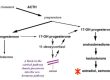
Dog owners — These dogs produce adrenal hormones that mimic Cushing’s disease. To understand the problem, start here. You’ll also find additional answers on the SARDS resources page.
Veterinarian ophthalmologists — I know it may be uncommon for you to follow up on these cases. So it’s possible you never hear the complaints described above. As you know, sex steroid excess is a common finding in SARDS. (1-4) It would be beneficial for the referring veterinarians to know this, too. That in turn, would benefit both patients and clients.
As early as 2009, Dr’s. Bentley, Carter, Oliver, et al recommended the routine evaluation of sex hormones in all SARD-affected dogs. (3)
Some ophthalmologists are concerned that by ordering such lab work they will be practicing beyond their scope. To them I would say this: Surely, the collection of a blood sample does not constitute the practice of endocrinology or immunology. And since you’ve been dispensing immunoglobulins and immunosuppressants for 40 years — such concerns now, seem unnecessary.
A few years ago I addressed the topic in detail. Here it is again:
In a perfect world, evaluation of sex steroids would begin at the ophthalmology clinic at the time of SARDS diagnosis. This would save clients time and expense because they’d already be in a veterinary facility where a blood sample could be collected and sent off. This time-savings could translate to improved patient outcomes.
Available assays :
-
-
- University of Tennessee Baseline Adrenal Panel (no ACTH necessary)
- National Veterinary Diagnostics E&I #1 Panel
- a progesterone level for those outside the USA.
-
Furthermore, the ophthalmic clinic should inform referring general practice veterinarians of the prevalence of elevated sex steroids in SARD-affected dogs and, of course, disclose the results of sex steroid assays. General practitioners repeatedly test these dogs for Cushing’s to no avail. They deserve to know about the high rate of sex steroid excess, which mimics Cushing’s.
Thereafter, dog owners would return to the general practice clinic where the referring veterinarian could manage low-dose hormone replacement. In a more perfect world, the ophthalmic clinic would actually discharge the patient with sufficient low-dose cortisol replacement to maintain the dog until the general practice appointment. This is very different than the anti-inflammatory dose that’s been prescribe for many years without benefit. This would be a win-win-win scenario.
I hope this information is helpful to you.
Best,
Caroline
1. Carter RT, Bentley E, Oliver JW, Miller PE, Herring IP. Elevations in Adrenal Sex Hormones in Canine Sudden Acquired Retinal Degeneration Syndrome (SARDS). Proceedings of the 34th Annual Meeting of the American College of Veterinary Ophthalmologists 2003;34: 40. (Scroll down to abstract #51 if you use the link.)
2. Oliver JW, Steroid Profiles in the Diagnosis of Canine Adrenal Disorders. Proceedings of the 25th Annual Meeting of the American College of Veterinary Internal Medicine 2007; 471-473.
3. Carter RT, Oliver JW, Stepien RL, Bentley E. Elevations in Sex Hormones in Canine Sudden Acquired Retinal Degeneration Syndrome (SARDS). Journal of the American Animal Hospital Association 2009; 45: 207-214.
4. Kamaromy AM, Abrams KL, Heckenlively JR, Lundy SK, Maggs DJ, Leeth CM, MohanKumar PS, Peterson-Jones SM, Serreze DV, van der Woerdt A. Sudden Acquired Retinal Degeneration Syndrome (SARDS) — a Review and Proposed Strategies Toward a Better Understanding of Pathogenesis, Early Diagnosis, and Therapy. Veterinary Ophthalmology 2015; 19: 319-331.